
Ceau, Cinema! 13
F-SIDES WILDCARDS
Project developed within the F-SIDES Wildcards 2026 Residency – a training program dedicated to film curation, conceived as a laboratory of ideas in which participants develop their own curatorial concepts in dialogue with industry professionals and international cinema networks.
The program encourages emerging voices to explore film curation from a personal, critical and reality-connected perspective and provides them with essential tools and resources for practicing this profession.
The films were curated and will be presented by Ruxandra Tripa and Carla Pantilie.
Teknolust
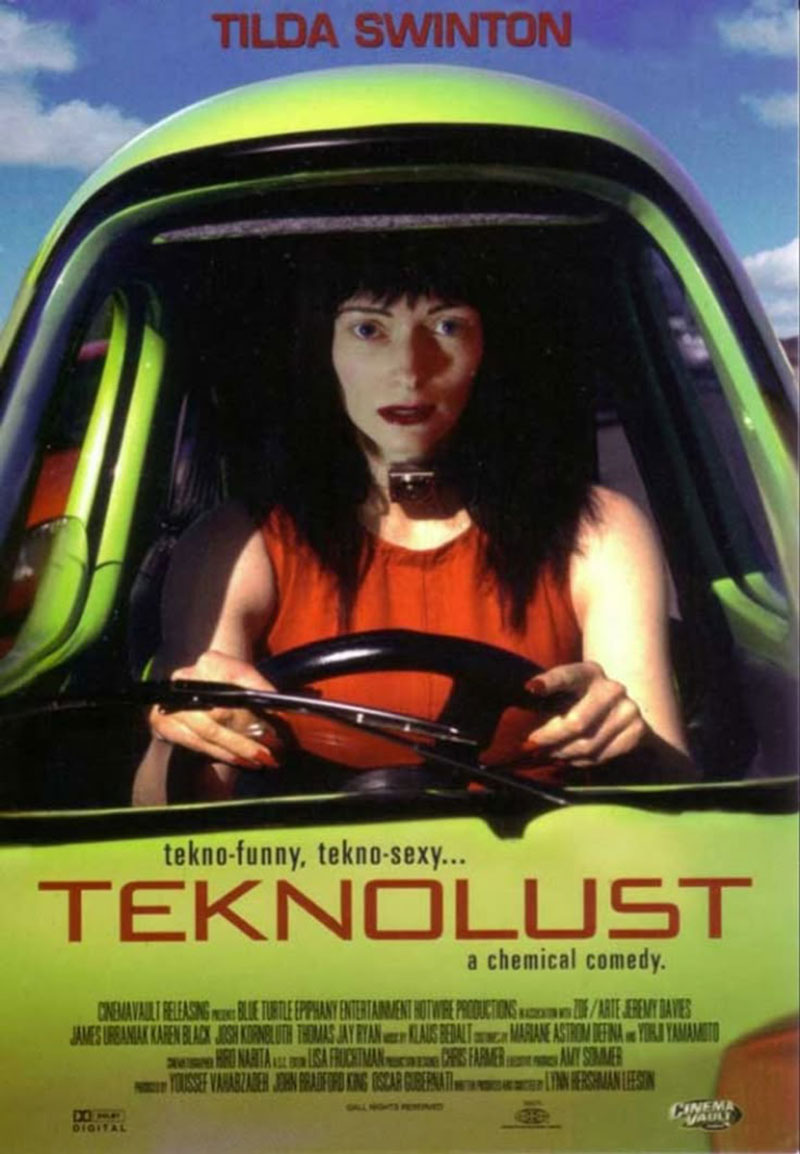
+15
Screening followed by a discussion with curators Ruxandra Tripa and Carla Pantilie
Director: Lynn Hershman-Leeson
Cast: Tilda Swinton, Jeremy Davies, James Urbaniak
Drama, Comedy, SF, Romance – UK — 2002 — 1h 25min
Language: English
Subtitles: Romanian
Synopsis:
Biogeneticist Rosetta Stone downloads her own DNA into an experimental A.I. program, creating a trio of cyborgian clones. The clones’ survival depends on injections of male Y chroma, only found in sperm. Ruby, one of the clones, ventures out and seduces men to secure their survival.
Festivals: Sundance, Toronto, Cannes, Berlin
Thursday, July 16, 2026, 08:30 PM
Victoria Cinema, Timișoara
The Slow Business of Going

+15
Screening followed by a discussion with curators Ruxandra Tripa and Carla Pantilie
Director: Athina Rachel Tsangari
Cast: Lizzie Curry Martinez, Maria Tsantsanoglou, Gary Price
Drama, Comedy – Greece, USA — 2000 — 1h 41min
Language: English
Subtitles: Romanian
Synopsis:
Petra Going is a migrant cyborg and agent of the Global Nomad Project, an “International Experience Data Agency” that sends hundreds of “receivers,” like herself, around the world to record random events and interactions. They periodically return to the agency’s headquarters to upload their memories into an archive that is later available to customers who can purchase and virtually experience the prefabricated experiences of tourist consciousness. The agency’s motto: “Nostalgia for Rent.”
Festivals: Salonic, Rotterdam
Friday, July 17, 2026, 08:00 PM
Victoria Cinema, Timișoara
“It’s My First Time Being Human”
Two Films About the Relationship Between Human and Technology in the Y2K Era
At the dawn of the new millennium, once the anticipated Y2K system collapse apocalypse failed to materialize, science fiction shifted its focus toward a future already embedded in the technological present. Characterized by a fascination with networks, virtual identities, and biotechnology, the Y2K imaginary reflects the thin line between excitement and anxiety in a world on the brink of a new digital era. Created within this context, Teknolust (2002, dir. Lynn Hershman Leeson) and The Slow Business of Going (2000, dir. Athina Rachel Tsangari) offer two contrasting visions of the relationship between humans and technology, articulated through the figure of the cyborg.
Teknolust occupies a space somewhere between science fiction and romantic comedy, while embracing a pop aesthetic reminiscent of early music videos and incorporating feminist themes. The story follows researcher Rosetta Stone (played by Tilda Swinton), who creates three cybernetic clones of herself on her computer. Although they share her appearance, the clones develop distinct personalities of their own, prompting them to take control of their destinies and venture into the real world.
Lynn Hershman Leeson transforms cyberspace into a realm of dreams, desires, and identity negotiation, all while maintaining a strong sense of self-irony. The film approaches technology with a certain degree of innocence and optimism about the future, firmly anchoring it in the historical moment in which it was made.
Hershman Leeson can even be regarded as a pioneer of certain internet pop aesthetics, anticipating key questions surrounding consent and autonomy in an increasingly digitized world, where these concepts seem to be gradually losing their meaning and power.
Producer of Yorgos Lanthimos’s earliest films, Athina Rachel Tsangari is one of the founding voices of the Greek Weird Wave, a movement whose distinctive absurd and dark comedic sensibility emerged as an attempt to articulate the effects of the 2008 Greek economic crisis.
Regarded today as a remarkable precursor to this movement, The Slow Business of Going marks Tsangari’s feature film debut.
The film’s protagonist, Petra Going, is a migrant cyborg and agent of the Global Nomad Project, an “International Experience Data Agency” that dispatches hundreds of “receivers” like her across the globe to record random events and encounters. Periodically, they return to the agency’s headquarters to upload their memories into an archive available to clients to purchase and virtually experience these pre-packaged fragments of tourist consciousness. The agency’s motto: “Nostalgia for Rent.”
The film’s narrative is set in motion when Petra suddenly experiences a feeling of homesickness for the first time in her life, despite having no personal memories of a place she could call home.
Exploring rootlessness and the state of perpetual transit, Tsangari constructs a critique of global capitalism and surveillance regimes through an experimental, fragmented structure. Each of Petra’s missions alludes to a different cinematic genre or tradition: from film noir to slapstick comedy and surrealism, performed in a detached, anti-naturalistic acting style influenced by the theatre of Samuel Beckett.
Both Teknolust and The Slow Business of Going are driven by the same fundamental question: what happens to identity when human experience can be stored, duplicated, and transferred? What does authenticity mean under such conditions? Against the backdrop of the rapid expansion of the internet, the identities of both films’ protagonists remain in a constant drifting state.
Ruxandra Tripa, Carla Pantilie